

Extended summer season provides boost to UK hotel industry
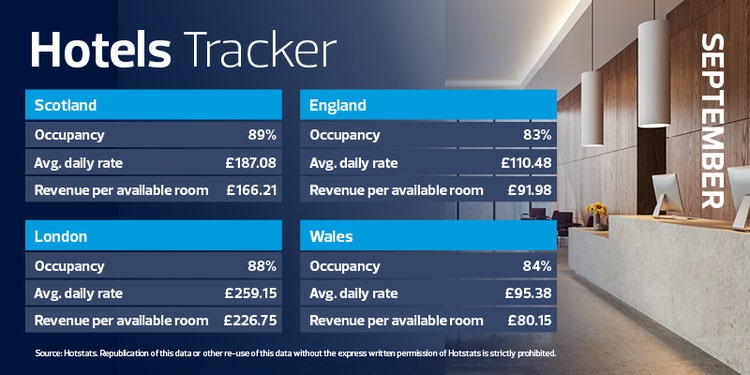
The extended summer period, helped by unseasonably warm weather, provided a boost to hoteliers in September but there are tougher months ahead for the sector, according to the RSM UK Hotels Tracker.
The data, which is compiled and produced by Hotstats and analysed by RSM UK, shows occupancy of UK hotels rose from 85% in September 2025 to 85.6% in September 2026 and was up marginally from 87.2% to 87.6% in London.
Average daily rates (ADR) of occupied rooms in the UK increased from £166.41 in September 2025 to £176.70 in September 2026 and jumped from £242.60 to £259.89 in London. As a result, revenue per available room (RevPAR) in the UK was also up from £141.52 in September 2025 to £151.28 in September 2026 and from £211.56 to £227.65 in London.
Gross operating profits of UK hotels rose slightly from 41.1% in September 2025 to 41.4% in September 2026 and was flat at 44.8% in London.
Chris Tate, partner and head of hotels at RSM UK, said: “The unseasonably warm weather throughout September and into October meant hoteliers reaped the benefits of an extended summer period. However, even with a boost to occupancy and room rates, UK hotels only saw a marginal increase in profit margins, while margins remained flat in London. Hoteliers are working incredibly hard to stand still as cost pressures continue to bite. One positive is the sustained demand from consumers, as without that, hoteliers will have seen profitability deteriorate.
“As we enter the colder months, combined with a sharp drop in consumer confidence in October, hoteliers will be feeling nervous about the months ahead. Another increase in the minimum wage announced in the Budget will be a further cost the industry needs to swallow. The hospitality sector is a huge employer of younger workers, but continued rises in wages, may mean employing this generation will simply become too expensive. The Chancellor’s cost of living support towards energy bills is welcome news, helping to put a bit more money in peoples’ pockets, but whether they choose to spend that on luxuries such as hotel stays is less certain.”
Thomas Pugh, chief economist at RSM UK, added: “Strong occupancy rates match the broad trend of solid consumer spending so far this year despite higher inflation and weak wage growth, which have dragged on households’ real incomes. Indeed, all the evidence suggests that households continue to smooth through the hit from higher energy prices through lower savings. Furthermore, the cost-of-living measures announced in the Budget will provide some support to real incomes, which helps to reaffirm our view that growth will hold up through the next six months or so, albeit at a more subdued pace.
“The backdrop of stronger than expected demand will make it easier for firms to pass on higher input costs to consumers. Indeed, hoteliers have already raised average daily room rates by 6.2% y/y, which has helped to provide some protection for margins against higher wage and energy costs. For the Bank of England, we think resilient demand and an improving labour market means the Monetary Policy Committee has run out of reasons to stay on hold, so we expect a hike on Thursday to help to limit the emergence of second-round effects.”